Discovery Park at Brackenhill Falls, Knysna
The envisaged Discovery Park on our doorstep will be a first in the world, putting both Knysna and South Africa on the map. Biomimicry attempts to follow the design principles of nature. The emphasis is not “green”, but to find solutions to problems. For example – more streamlining in jets. That it looks to nature, where there is no destruction in construction, and development takes place with a symbiotic relation to the surrounding environment, the solutions would more than likely be environmentally supportive.
This project is the brainchild of SUSAN SWAIN. She was our guest at the NCOA’s 2013 AGM.
Sue Swain has had an interest in Biomimicry since 2004 and attended the Biomimicry in Design Workshop with Janine Benyus in September 2009. Motivated by the belief that biomimicry is something that can be applied in all areas of our lives, Sue has been working on a model for the Garden Route town of Knysna based on the principles, strategies and processes of a natural system.
These principles have been distilled into a model to help Knysna “function like a forest”. The model can be used to guide how we run our businesses, live our lives, plan and run the town, and solve any number of problems from design challenges to tourism-related issues. Sue has also just received funding from the National Lotteries Board, from a funding proposal submitted in 2005, to coordinate the research and design of and fund-raise for the establishment for a Biomimicry Discovery Park. This will essentially be a public education facility and eco-tourism attraction rolled into one very interactive, fun and engaging park designed to immerse people in the fascinating world of nature and reveal how we can draw lessons from all we see around us.
Before we headed out to the site where we spent the afternoon, we were treated to a talk by CLAIRE JANISCH.
Claire, a chemical engineer, is a sustainability & innovation advisor and biomimicry professional. She is a graduate of and a co-trainer for the international 2-year biomimicry Professionals Program. She currently heads up biomimicrySA. Claire works in the areas of strategy, technology & education and is the leading presenter, trainer and consultant for biomimicry in South Africa. She is also a co-creator of the Genius Lab, an experiential learning organisation inspiring innovation and future thinking for organisations and individuals (children and adults). She finds inspiration and innovative solutions to human challenges by emulating organisms and ecosystems that fit in on this beautiful planet in well-adapted life-enhancing ways. As a biomimicry professional she spends her time exploring nature’s technological miracles in diverse ecosystems and shares this new way of viewing and valuing nature through expeditions and workshops – teaching & training professionals, students and scholars. She also dives deeper into research for companies and organisations- translating nature’s innovation and sustainability principles for the design of new products, processes & systems. Claire has a MSc in the field of Environmental Process Engineering and has worked across Africa as a consultant in: Environmental Technology, Sustainable Energy & Climate Change, Cleaner Production, Sustainable Urban Design, Integrated Waste Management, Sustainable Agricultural Practices, Eco-labelling, Environmental Management & Environmental Education. Claire was selected in the Mail & Guardian’s 200 young South Africans in 2010 and 2011. She was a finalist in the Most Influential Women in Business & Government awards in 2012.
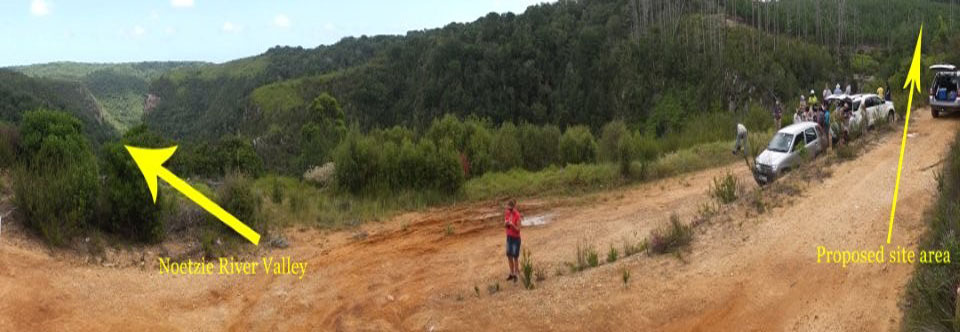
On site we were given a field talk by local Field Guide expert Mark Dixon who gave us some background to the site in terms of geology, weather patterns, flora and micro organisms and did you know that only 30 percent of the organisms we call our body is made up of us ..? The rest is made up of microbes, bacteria and other parasites we host. A glass or two of wine a day, I say ! And that the ratio of human to insects is 1: hundreds of millions ?
The architect who is very keen on this project and as far as I can make out, will be the architect, is Mick Pearce. He is a designer of living buildings, the Eastgate Centre in Harare being the most famous. What a lovely man and being with him was awesome.
John Todd who wrote a book called LIVING MACHINES will be the next guest to the project in October. He is a world expert on water.
The other outstanding giant mentioned is Wes Jackson, a Texan who wrote about farming the Prairies using bio biomimetic principles. His book is considered a bible of green agricultural practice CONSULTING THE GENIUS OF THE PLACE.
Here is some dinner table info to keep your guests in gusts of interest :
A Tardigrade is a microscopic organism which can be boiled, frozen or dehydrated for 120 years. Undo it and it gets up and walks away. They have used that concept of myothelial sugar coating to successively transport vaccines, thereby reducing fridge costs and accidental loss of stock through breaks in the cold chain
They have made a polymer called SHRILK, which is a fabric with silk properties – stronger than anything man has made in the past.
Biomimicry is an attempt to solve problems by asking different questions. Look to the problem..ask the question..locate the verb and ask what nature does with that verb. We workshopped that in groups with Claire it was very interesting.
 We usually think of recycling as “cradle to grave” or down-cycling , and yet nature recycles in the “cradle to cradle” or re cycling style.
Mick Pearce explains Architecture as the “third skin”. Our skin is first, our clothes are second and our shelters are the third.
Early architecture was based on fire…and now our “fire” comes from a plug in the wall. The invisible nature of our fire from the principle of energy is seen to be problematic in the way that much modernity is… we are removed from the essence. For example, the humble plastic water bottle has nearly as much equity value, in terms of mined carbon,…as…you can hardly believe it…DIAMONDS !!!
The idea for developers is to use the tree as the example. The tree is a complete living organism which re cycles. Further, it is decentralised – each leaf is self sufficient. The idea would be to have buildings which are modular and each mode being self sufficient in terms of energy, water and waste. This would take away the clumsiness of centralised processing.