Noetzie has always been difficult to reach, but once there, it is always worth it. The archaeological evidence confirms that Noetzie was inhabited by the Southern Cape’s earliest inhabitants.
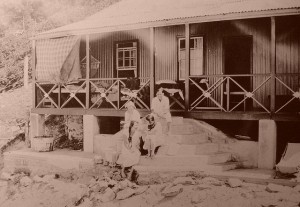
Thousands of years later, modern man discovered Noetzie, and they used ox wagons to build the Old Wagon Road to the beach and erect iron and timber holiday cottages on the edge of the beach and river. They were oblivious to environmental concerns like rising sea levels and building in flood plains. The cottages were small and were visited mostly during warmer months. So Noetzie stayed a secret and remote destination for local fishermen, determined campers and a few holiday makers.
In the 1940s the castle builders built a private road to the new castle on the west end of the beach, and the public steps to the beach were also built joining up to this road. From the 1970s, river cottage owners have been able to access their properties but have to cross private land.
In 2000, when the remainder of Noetzie farm was sold to a developer, gentlemen’s agreements from bygone days fell away, and for the first time, access across the Noetzie farm to the beach was threatened. We all wished that the public parking area, the public and private access routes to Noetzie had been formalized before the sale.
Soon after approval of the development, access was used as a threat because the Noetzie homeowners had objected to the developer’s plan to abstract water from Noetzie River (for the development’s golf course at Sparrebosch).
Then the Pezula developer purchased the Noetzie Castle and closed off the access via the steps. Thanks to a loud and passionate public outcry, a public protest on Heritage Day 2006 and a court case, the developer was forced to re-open the access to the beach via the steps, and this access will remain open into the foreseeable future.
(See the SC Legal Opinion and several other documents on the Noetzie website for more information)
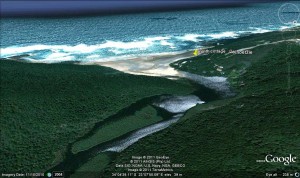
Just because there are always fresh challenges at Noetzie, since the public steps access was sorted out, the other route to the beach via the Old Wagon Road now ends in the air, with the river a few metres below. Although environmentally friendly solutions are being considered, so that property owners with 4x4s and permits can access their houses via the beach again, this access will only ever be possible as long as the sea, river and high tides allow it.
“You cannot command Nature, except by obeying her” Francis Bacon
We have had a number of enquiries about weddings on Noetzie beach. This is a copy of our usual response. Noetzie is a public beach and cannot be booked for any private function. However permission needs to be obtained from the Knysna Municipality – 044 302 1605. If you choose to take your vows on the beach please keep the following in mind:
No alcohol may be consumed on the beach
No amplified music or loud hailers
No vehicles on the beach – any vehicle in violation of this regulation may be confiscated and the driver fined.
No structures may be erected
No parking on the Old Wagon Road – only in the public parking area at the top of the hill.
All litter (yes we are including rose petals, etc.) must be removed and placed in refuse bins in the carpark
No disturbance to other members of the public or residents
No commercial activities
No digging or disturbance/removal of sand, rocks, driftwood or any fauna and flora
All other National, Provincial and Municipal regulations, not listed above, must also be adhered to at all times.
Noetzie Township is more than 100 years old. Here are some photos of all the fun people have had at Noetzie over the years. Bird watching, fishing, hiking, boating on the river, surfing. Not much has changed, except perhaps there were more fish in those days and Noetzie people could take the Coffee Pot Train trip to the village. No more free rides, no more train or tracks. Ah yes, there now are electric fences around the adjacent luxury estate, preventing fishermen and hikers from taking short cuts over the headlands to get to secret fishing spots, but otherwise, Noetzie really is just the same as 100 years ago.
The tide line at Noetzie Beach is a long and winding treasure chest. Beautiful bleached driftwood, a few special shells and amazing creatures.
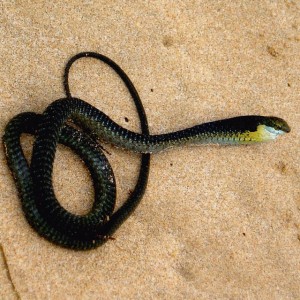
Sadly, litter from the polluters out at sea and Knysna's storm water drains also line the shore. We started cleaning the tide-line a few years ago and this has also trained our eyes to find and locate all objects that are out of place or beautiful. We once found an injured Boomslang. It was almost in the sea water and still moving, we guessed that a bird could have dropped it onto the beach. We carefully placed it back in the forest, using a pair of braai tongs.
Imagine having a snake fall out of the sky right next to your relaxing tanning body?
Other interesting finds were scores of dead pipefish. See Fran Kirsten's article , in full published in the Knysna Plett Herald
Scores of Pipefish Dead
01:00 (GMT+2), Thu, 08 December 2011 KNYSNA NEWS - "We have been finding dead pipefish washed up on the Noetzie Beach tide-line for over a month now, lots and lots. We collected 60 without looking too hard," said a saddened Knysna resident.
These pipefish (Syngnathus Capensis) are related to the seahorse and occur in all the local estuaries and are preyed on by various fish species that enter the estuaries. The resident offered a hypothesis, "Perhaps the dredging at Ashmead or somewhere in the lagoon, or the recent pollution from sewage, is killing them, and the westerly winds then wash them onto Noetzie Beach."
Another report of dead pipefish was received from a diver who had recently dived at the Knysna Heads. "It is the sewage" he said, "I went for a scuba dive on Friday, December 2 and I saw lots [dead pipefish] at The Heads."
Professor Brian Allanson, Knysna resident and aquatic and estuarine ecologist said, "To have such a high mortality, points to a major environmental disturbance." He explained that pipefish prefer to live within the estuary’s eelgrass beds. "If these beds are exposed to pollution, then the pipefish will be exposed to many dangers - predation or rapid lowering of dissolved oxygen linked to sewage pollution and associated toxic compounds such as dissolved ammonia."
Allanson added that he was "tempted to point a finger at the recent extreme sewage pollution of the estuary. This would have reduced dissolved oxygen and introduced ammonia." In closing he said that the fact that the dead pipefish have been washing up for over a month, suggests that a major pollution event was the most likely cause.
André Riley, area manager for Knysna Garden Route National Park, said that although it is often difficult to pin-point the cause of high mortalities in the environment, he agreed with Allanson that "it [the dead pipefish] is linked to an environmental event. However these events are in some cases natural and/ or as a result of disturbances caused by humans."